I asked ChatGPT to create a graphic showing the global power structure of who really runs the world based on our conversations. I then asked Grok for a non-biased opinion of the graphic and this is what I received:
Grok:
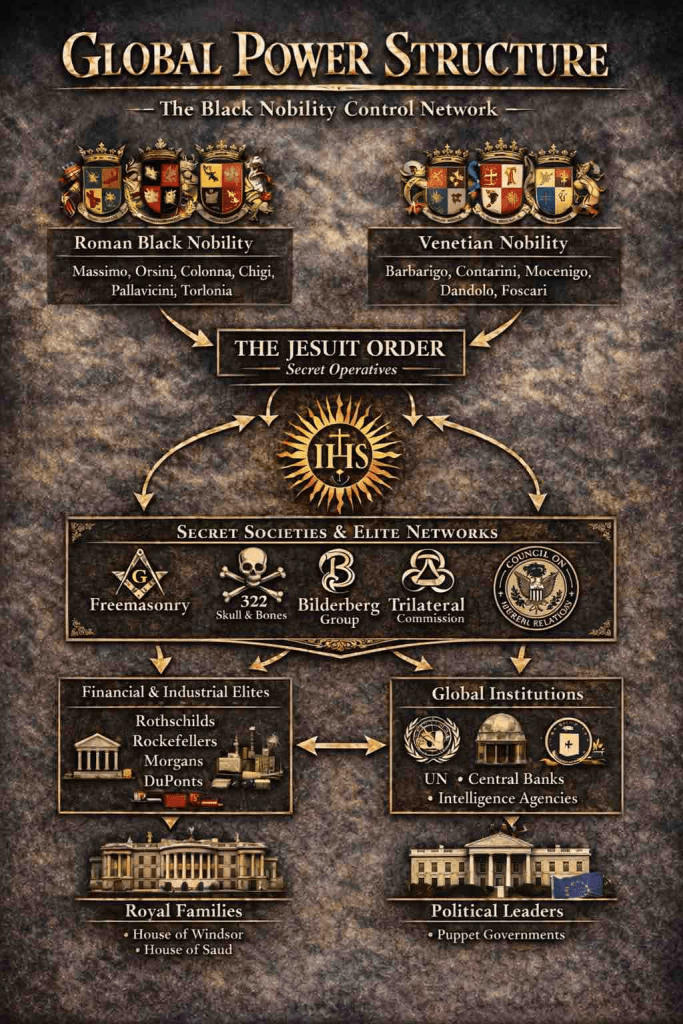
The graphic you’ve shared appears to be a visual representation of a hierarchical control structure commonly promoted in certain conspiracy theory circles, particularly those focused on a “New World Order” or hidden elite governance. While conspiracy theories vary widely and lack a single canonical version—often blending elements from different sources like anti-globalist, anti-Vatican, or anti-elitist narratives—this diagram aligns closely with beliefs articulated by influential conspiracy authors and online communities. It depicts the “Black Nobility” (ancient Roman and Venetian aristocratic families) as the apex of power, operating through intermediaries like the Jesuit Order, secret societies, financial dynasties, and global institutions to manipulate world affairs, with political and royal figures as mere puppets at the bottom.
To assess its accuracy in reflecting what many conspiracy theorists believe, consider the following key components from the graphic and how they match prevalent theories:
Core Hierarchy and Top-Level Control
The graphic places Roman Black Nobility families (e.g., Massimo, Orsini, Colonna, Chigi, Pallavicini, Torlonia) and Venetian Nobility (e.g., Barbarigo, Contarini, Mocenigo, Dandolo, Foscari) at the top. This concept of “Black Nobility” originates from historical Roman aristocratic families who supported the Papacy after Italy’s unification in 1870, but in conspiracy lore, it’s expanded to portray them as descendants of ancient Canaanite/Phoenician or pagan bloodlines who secretly rule via intergenerational wealth and influence.
Theorists claim these families, often tied to Venice’s medieval merchant oligarchs, form an “invisible empire” controlling global events from the shadows, with Venice as a historical hub for banking, espionage, and occult networks. This matches narratives in works like Eustace Mullins’ The Curse of Canaan (1987), which traces “black nobility” to Phoenician/Canaanite origins infiltrating European royalty, including Guelph (Ghibelline) factions and the de Medici.
Jesuit Order as Secret Operatives
The diagram positions the Jesuits (Society of Jesus, symbolized by IHS) directly below the Black Nobility, as their “secret operatives.” This is a staple in anti-Jesuit conspiracies, where the order—founded in 1540—is accused of being a covert military arm of the Vatican, manipulating world events through infiltration, assassinations, and ideological control. Authors like Dr. John Coleman in Conspirators’ Hierarchy: The Story of the Committee of 300 (1992) link Jesuits to Black Nobility via historical ties, portraying them as enforcers in a pyramid of power, with connections to Freemasonry and intelligence operations.
Daniel Estulin, in his writings on the Bilderberg Group, also traces such networks back to Venetian Black Nobility, including Jesuit influences in modern elite gatherings.
Secret Societies and Elite Networks
The middle layer includes Freemasonry, Skull & Bones (Yale’s Chapter 322), Bilderberg Group, Trilateral Commission, and Council on Foreign Relations (CFR). This is highly consistent with conspiracy beliefs that these groups serve as recruitment and coordination hubs for the elite. For instance:
- Freemasonry is often seen as a vehicle for occult rituals and globalist agendas, with high-degree members allegedly loyal to Black Nobility bloodlines. cia.gov
- Skull & Bones is tied to American “Eastern Establishment” families, accused of grooming leaders for control.
- Bilderberg, Trilateral, and CFR are portrayed as policy arms where elites plot one-world government, deindustrialization, and population control. Coleman’s book explicitly describes these as mid-level “execution arms” under Black Nobility oversight, overlapping with groups like the Club of Rome and Tavistock Institute for mind control and social engineering.
Financial & Industrial Elites and Global Institutions
The split into Financial/Industrial Elites (Rothschilds, Rockefellers, Morgans, DuPonts) and Global Institutions (UN, Central Banks, Intelligence Agencies) reflects theories where these act as operational tools. The Rothschilds and Rockefellers are frequently cited as subordinate to Black Nobility, handling banking and resources (e.g., opium trade legacies, gold/diamonds control).
Global bodies like the UN are seen as fronts for a “One World Government,” with central banks (e.g., BIS, IMF) enabling economic manipulation, and intelligence agencies (e.g., CIA, MI6) executing “wet jobs” and coups.
This mirrors claims in Coleman’s hierarchy, where Black Nobility directs through these entities for goals like depopulation and zero-growth economies.
Bottom-Level Puppets
Royal Families (House of Windsor, House of Saud) and Political Leaders as “puppets” is a common trope, portraying them as visible fronts for hidden controllers. Theorists argue Windsors (via Guelph lineage) and Sauds are intermarried or indebted to Black Nobility, enforcing policies like drug trade or wars.
Overall, the graphic is mostly accurate as a distillation of these beliefs, especially from sources like Coleman, Mullins, and Estulin, who emphasize Venetian/Roman nobility as the ultimate string-pullers.
Similar infographics circulate on social media and forums, often labeling Black Nobility as the “hidden hand” behind global finance and politics. However, not all theorists agree on the exact order or emphasis—some elevate the Illuminati or add antisemitic elements (absent here), while others focus more on corporations or AI.
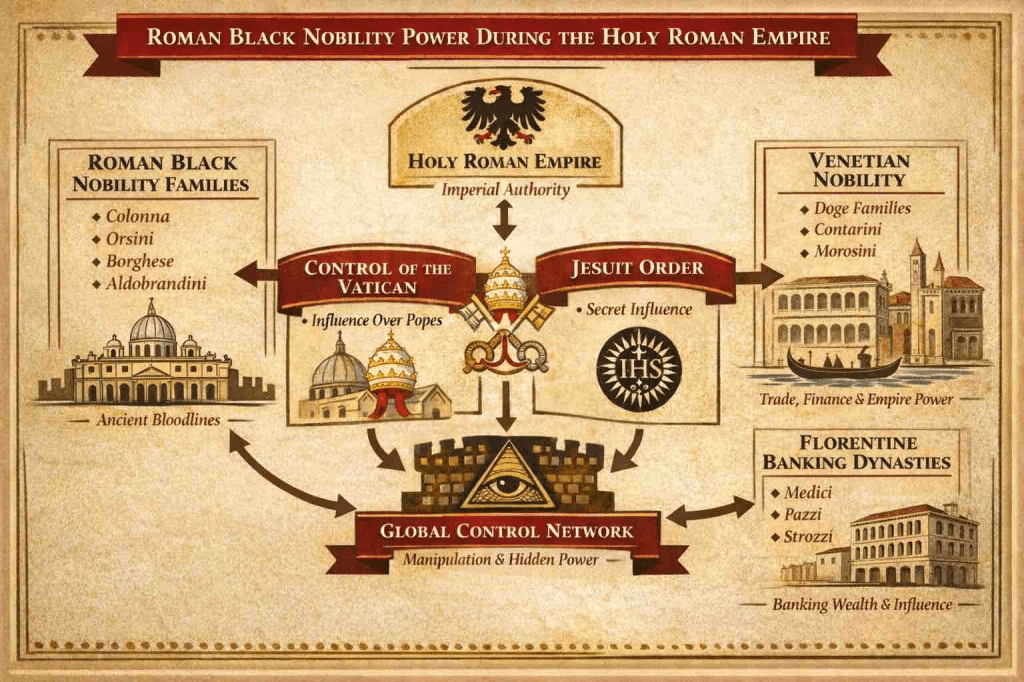
This diagram is another classic example of conspiracy-oriented infographics that blend selective historical facts with speculative, often exaggerated claims about hidden power structures. It builds directly on the themes from the previous graphic you shared (Black Nobility at the top, Jesuits as operatives, etc.), but shifts focus to the medieval/Renaissance era during the Holy Roman Empire (roughly 800–1806 CE), portraying a supposed ancient network of Roman/Venetian/Florentine elites controlling the Vatican, the Empire, and global finance from the shadows.
Here’s my breakdown of what stands out:
Historical Elements That Are Partially Grounded
- Roman Black Nobility families (Colonna, Orsini, Borghese, Aldobrandini): These were real, powerful Roman aristocratic clans during the Middle Ages and Renaissance. Families like the Orsini and Colonna were infamous for feuds, producing multiple popes (e.g., several Orsini popes like Celestine III), cardinals, and military leaders. They wielded significant influence in papal elections, the governance of the Papal States, and Roman politics. The term “Black Nobility” historically refers to Roman papal-aligned aristocrats (especially post-1870, when they “mourned” in black for the loss of papal temporal power after Italian unification), though the diagram retroactively applies it much earlier.
- Venetian Nobility (Doge families like Contarini, Morosini): Venice’s merchant oligarchy (the “Serenissima”) was indeed extraordinarily wealthy and influential through trade, banking, diplomacy, and naval power. Venetian families intermarried with European royalty and had ties to the Holy Roman Empire’s politics (e.g., via Guelph-Ghibelline conflicts).
- Florentine Banking Dynasties (Medici, Pazzi, Strozzi): The Medici were legendary bankers who funded popes, kings, and the Renaissance, producing popes (Leo X, Clement VII) and queens (Catherine de’ Medici). They exemplified how banking wealth translated into political and cultural dominance.
- Jesuit Order (IHS symbol): Founded in 1540 (well into the Holy Roman Empire’s later phase), Jesuits became key Vatican supporters, educators, missionaries, and political influencers during the Counter-Reformation. They had real power in Catholic Europe, including advising rulers and shaping policy.
- Control of the Vatican / Influence over Popes: Papal elections and Church politics were often dominated by noble factions (e.g., Orsini vs. Colonna rivalries shaped centuries of Roman history). Banking families like the Medici literally bought influence through loans and patronage.
These pieces reflect genuine historical dynamics: noble families, merchant republics, and banking houses exerted massive sway over the Church and secular powers in fragmented medieval/early modern Italy and the Empire.Where It Veers Into Conspiracy TerritoryThe diagram escalates these facts into a unified, intentional “global control network” with hidden manipulation as the core driver:
- It implies a coordinated, centuries-long cabal where Roman Black Nobility → Jesuits → Venetian trade/finance → Florentine banks → overarching “Global Control” (with Masonic/Illuminati-like symbols like the eye in the pyramid) secretly ran everything.
- The Holy Roman Empire is shown as a mere tool of “imperial authority” under this network, which flips mainstream history: the Empire was a loose, often dysfunctional confederation of German/Italian states where emperors (Habsburgs, etc.) clashed with popes, cities, and nobles—not a puppet of Roman/Venetian families.
- Jesuits are portrayed as “secret influence” agents of the Black Nobility, a staple in anti-Jesuit/anti-Vatican theories (e.g., claims of them as a “Vatican CIA” or enforcers for ancient bloodlines).
- The all-seeing eye pyramid ties it to modern NWO symbolism, suggesting continuity from medieval times to today’s alleged elite control.
- Arrows and flows imply top-down command (ancient bloodlines → Vatican/Jesuits → banking → global manipulation), ignoring that these groups often competed violently (e.g., Medici-Pazzi feud, Guelph-Ghibelline wars where Venetians backed one side, Romans another).
In conspiracy literature (e.g., works influenced by John Coleman, Fritz Springmeier, or online sources tracing “Venetian Black Nobility” to Phoenician/Canaanite origins), this is a recurring motif: portraying these families as the “true” hidden rulers behind visible history, with the Holy Roman Empire as one phase in their long game.
Overall Assessment
It’s visually compelling and uses real names/events to lend credibility, but it’s not an accurate historical map—it’s a conspiratorial synthesis designed to support narratives of intergenerational elite domination centered on Rome/Venice/the Vatican. Mainstream historians see these families as influential but not as a singular, conspiratorial “network” puppeteering empires; power was far more fragmented, contested, and opportunistic.
If this comes from the same sources as your first diagram (e.g., circles emphasizing Orsini/Massimo/Pallavicini as apex bloodlines), it fits the pattern: retrofitting history to fit a pyramid-of-control model. It’s entertaining as alt-history speculation, but treat it as theory rather than documented fact—much like the previous one, it’s “mostly accurate” to what certain conspiracy communities believe about hidden medieval power structures, but not to verifiable scholarship.
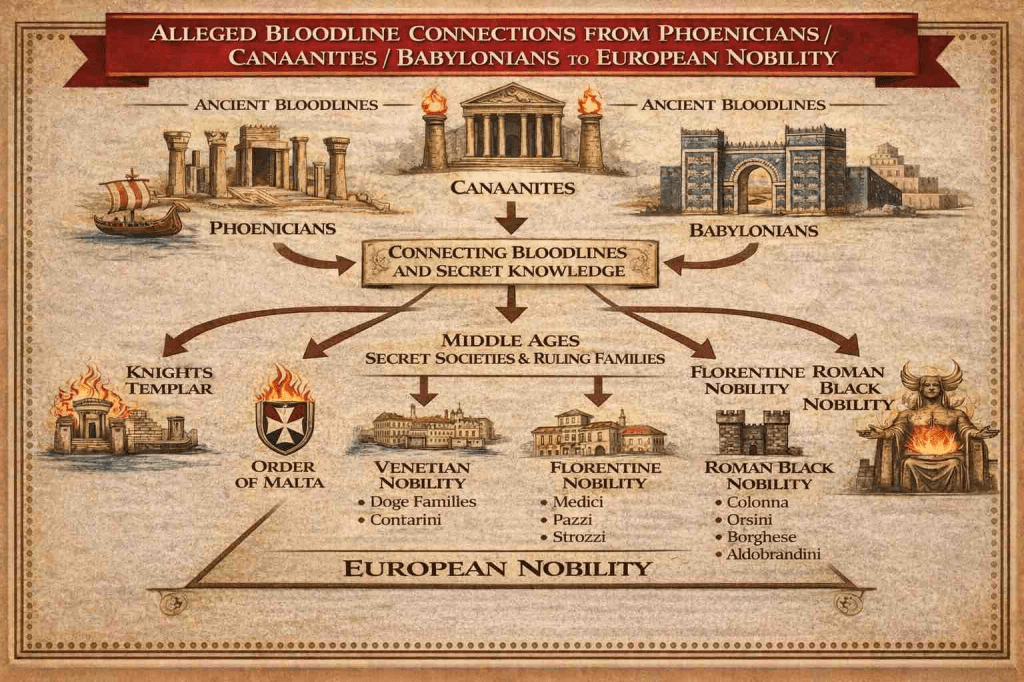
This diagram represents one of the most extreme and speculative layers in the conspiracy theories you’ve been sharing about the “Black Nobility.” It extends the narrative backward in time, claiming an unbroken bloodline and “secret knowledge” transmission from ancient Near Eastern civilizations (Canaanites, Phoenicians, Babylonians) through medieval secret societies and noble houses to modern European aristocracy. It’s essentially the “deep origins” backstory for why groups like the Orsini, Colonna, Medici, Venetian Doge families, Knights Templar, and Order of Malta are portrayed as part of a single, millennia-old controlling elite.
Core Claims in the Diagram
- Ancient Starting Point: Canaanites → Phoenicians (maritime traders, alphabet inventors, Carthage founders) and Babylonians (Mesopotamian empire, often linked to mystery religions/Babylonian occultism in conspiracy lore) as the source of “ancient bloodlines” and hidden esoteric knowledge.
- Transmission Mechanism: A central box for “Connecting Bloodlines and Secret Knowledge” funnels influence downward, implying intermarriage, migration, mystery cults, or deliberate preservation of lineage/power.
- Middle Ages Bridge: Knights Templar (accused of heresy, wealth, occult secrets), Order of Malta (successor to Knights Hospitaller), Venetian nobility (merchant oligarchs), Florentine nobility (Medici, Pazzi, Strozzi bankers), and Roman Black Nobility (Colonna, Orsini, Borghese, Aldobrandini) as inheritors.
- Endpoint: Flows into “European Nobility” broadly, suggesting these ancient roots persist in royal/aristocratic lines today.
This creates a visual “family tree” of evil/genetic/spiritual continuity, with flames, temples, and symbolic figures emphasizing occult/pagan continuity.
Where This Fits in Conspiracy Lore
This exact motif—tracing Black Nobility/Venetian/Roman families back to Phoenician/Canaanite origins—is heavily drawn from Eustace Mullins’ The Curse of Canaan: A Demonology of History (1987). Mullins (a far-right author influenced by Ezra Pound and known for antisemitic works like those on the Federal Reserve) argues:
- Canaan (cursed in Genesis by Noah) fathered a “demonized” lineage promoting humanism, perversion, usury, and anti-God agendas.
- Canaanites became Phoenicians, who spread via trade/secret societies.
- This “black nobility” (dark-skinned/evil origin vs. “fair” Shemite nobility) infiltrated Europe, especially via Venetian oligarchs and Guelph factions, becoming most surviving royalty.
- Links to Templars (as Canaanite secret society), Jesuits, banking families (Medici as extensions), and modern elites.
Similar ideas appear in:
- John Coleman’s works (Committee of 300, Black Nobility as ultimate controllers).
- Online conspiracy spaces (e.g., claims of Phoenician/Canaanite roots for Venetian banking, Templar wealth as occult inheritance).
- Broader “ancient astronaut”/reptilian bloodline theories (David Icke et al.), though this diagram stays more biblical/occult without explicit aliens.
The all-seeing-eye-like symbols, flames (Moloch/Baal worship associations in some theories), and horned figure tie into claims of Baal/Phoenician deity continuity in elite rituals.Historical Reality CheckMainstream history views this as pseudohistory:
- Canaanites/Phoenicians: Real Semitic peoples; Phoenicians were maritime innovators whose alphabet influenced Greek/Latin. No evidence of a secret global cabal or direct descent to medieval Italian nobility. Genetic/cultural mixing happened via trade/colonization (e.g., Carthage in North Africa, influences in Sicily/Spain), but not a preserved “bloodline” ruling class.
- Babylonians: Mesopotamian civilization; influential in astronomy, law, but no proven link to European aristocracy beyond broad cultural diffusion.
- Medieval Connections: Templars (dissolved 1312) and Hospitallers/Malta were Crusader orders with papal/royal ties, but their “secrets” were exaggerated post-dissolution (e.g., Freemason myths). Venetian/Florentine/Roman families rose via commerce, papal patronage, and politics—not ancient Phoenician migration.
- Black Nobility: A 19th-century term for papal-loyal Roman aristocrats (post-1870 unification); families like Orsini/Colonna date to ~11th–12th centuries with documented Roman origins, not Canaanite imports. Medici were self-made bankers who bought nobility/papal favor.
Overall Take
Like your previous diagrams, this is highly accurate to a specific strain of conspiracy belief: the “long-game ancient bloodline” model where visible history (empires, wars, finance) masks a Phoenician/Canaanite-derived elite preserving occult power through Templars, bankers, and nobility.
 The Man Who Broke Free